Timeless Trios: A Celebration of Three Masters
Mozart: Piano Trio No.3 in B-flat major, K.502
Shostakovich: Piano Trio No.1 in C major, Op.8
Brahms: Piano Trio No.1 in B-flat major, Op.8
Sunday 23 February 2025, Callaway Music Auditorium, University of Western Australia
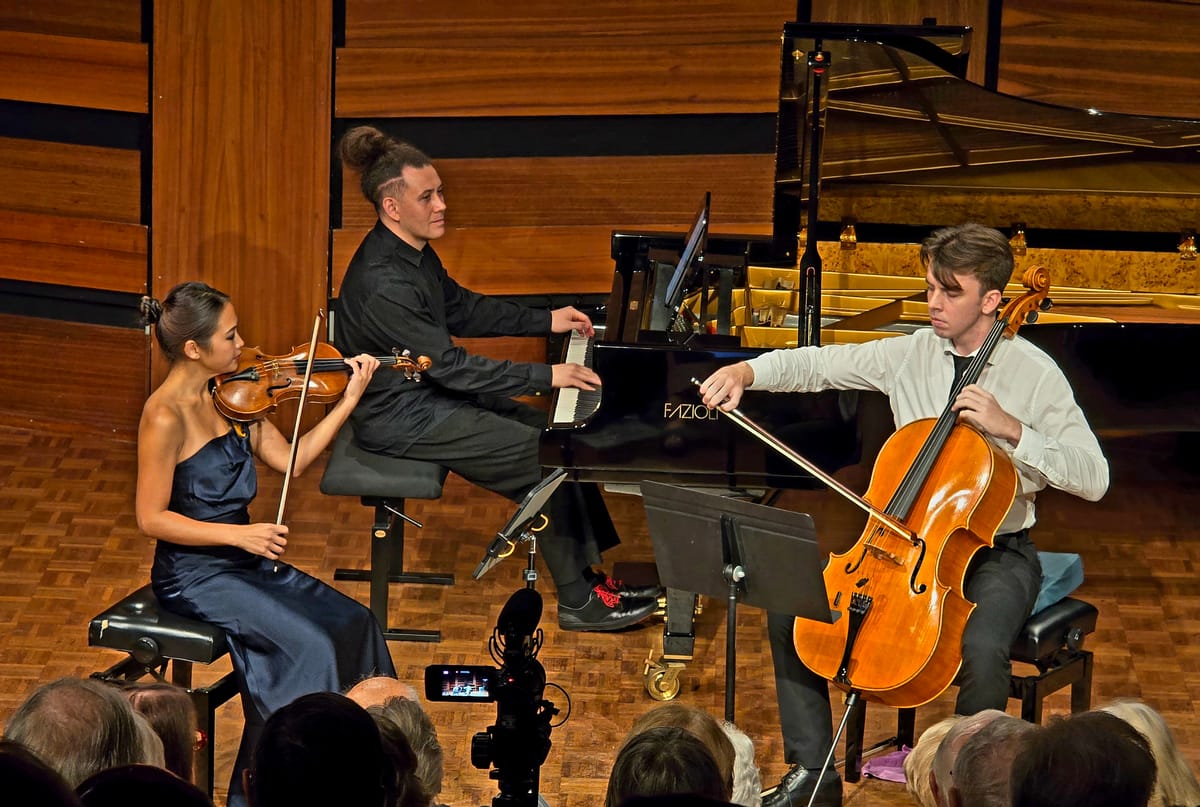
This immensely enjoyable chamber music recital afforded a rare opportunity to experience the evolution of the piano trio across three distinct musical epochs. Performed by the ensemble of Kylie Liang (violin), Isaac Davis (cello), and Liam Wooding (piano), the program traced a compelling narrative through masterworks by Mozart, Shostakovich, and Brahms.
Mozart’s Piano Trio No. 3 in B-flat major opened the evening with characteristic elegance. Wooding’s articulate piano introduced the graceful primary theme of the Allegro with pristine clarity, soon joined by Liang’s responsive violin in perfect dialogue. The trio achieved remarkable balance throughout, particularly in the Larghetto, where Mozart’s operatic sensibilities shone through. Davis’s cello provided a warm foundation for the conversational exchanges, while Wooding’s ornamented commentary demonstrated his sensitivity to Mozart’s intricate textures. The Allegretto finale sparkled with wit, the performers navigating Mozart’s unexpected harmonic shifts with playful precision.
The transition to Shostakovich’s youthful Piano Trio No. 1 represented a dramatic shift in musical language. Composed when the Russian was merely 17, this single-movement work revealed fascinating premonitions of his mature style. Davis opened with the passionate cello theme, his rich tone capturing the emotional intensity of this early work. The trio navigated Shostakovich’s harmonic ambiguities and abrupt mood changes with conviction, particularly impressive given Davis’s personal connection to this composer, having won the 2022 ANAM Concerto Competition with Shostakovich’s First Cello Concerto. Wooding’s background in contemporary music proved invaluable here, bringing clarity to the modernist elements while maintaining the work’s romantic undercurrents.
The evening culminated with Brahms’s Piano Trio No. 1 in its original 1854 version. This choice was particularly illuminating, offering insight into the 21-year-old composer’s voice before his famous 1889 revision. Liang’s violin captured the soaring lyricism of the expansive first movement with passionate intensity, while Wooding (who has recorded Brahms previously) brought authority to the ambitious piano writing. The Schumannesque influences in the scherzo were vividly realised, with Davis’s cello providing rhythmic propulsion. Most affecting was the Adagio, where the trio embraced the unrestrained emotionalism of young Brahms with heartfelt sincerity. The rhapsodic finale, with its allusions to Schubert and cyclical references, emerged as a tour de force of Romantic expression.
What made this performance exceptional was the ensemble’s thoughtful approach to each composer’s distinct musical language. Liang’s extensive orchestral experience brought precision to Mozart, while her chamber music background allowed for expressive freedom in Brahms. Davis demonstrated remarkable versatility across all three works, his technical command equally impressive in Shostakovich’s modern idiom and Brahms’s Romantic effusiveness. Wooding proved the perfect musical partner, his versatility as a pianist evident in his seamless transitions between Classical restraint, early modernism, and Romantic abandon.
Kudos to Wooding and his musical colleagues for taking the initiative and providing some marvellous chamber music fare (there was a recital the previous day, too, which unfortunately I missed) for audiences who felt short-changed by the lack of such content in the current Perth Festival program.