Symphonies in five elements
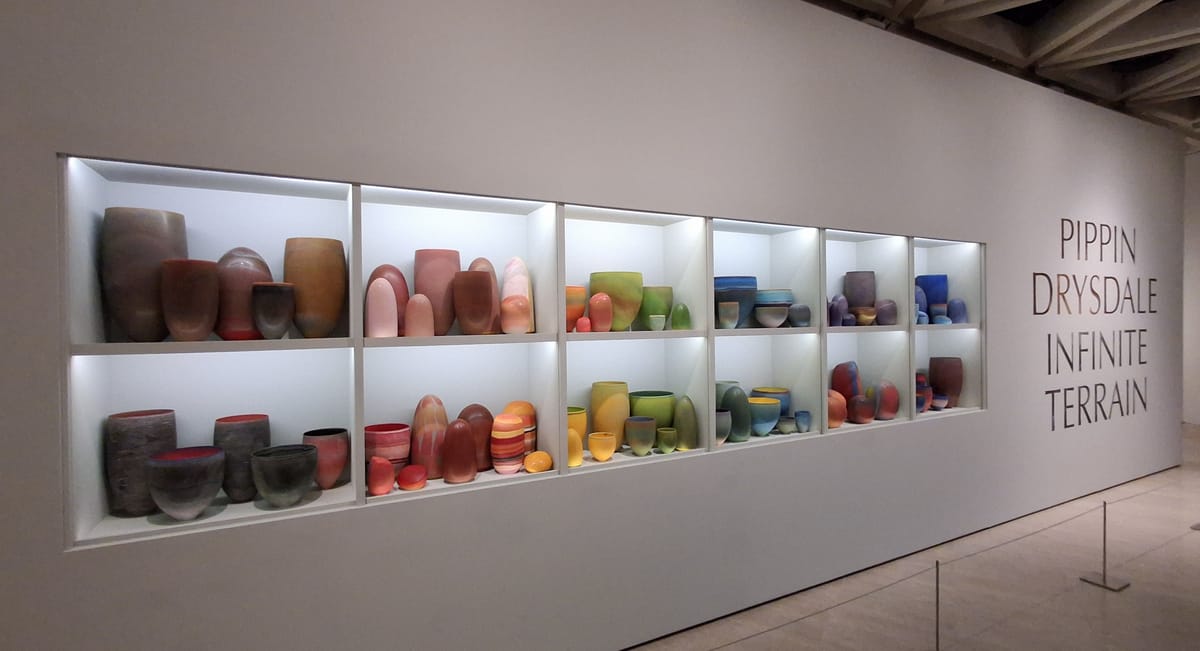
At 82, Drysdale remains restlessly inquisitive. Infinite Terrain demonstrates not a summation but an ongoing conversation between material, memory and place.
Pippin Drysdale: Infinite Terrain is not just a retrospective. It is a cartography of attention: four decades of looking, travelling, refining and returning. Drysdale’s achievement lies in her capacity to translate vastness into intimacy, geology into breath. In her hands, clay ceases to be earthbound. Through process and product, her ensembles are symphonies in five elements.
Surveying more than 40 years of work, the exhibition, exquisitely curated by Isobel Wise and on at the Art Gallery of Western Australia until 6 April, reveals a practice driven less by stylistic rupture than by accretion – layer upon layer of seeing. From the early lustred bowls of the 1980s and 90s to the radiant installations of recent years, Drysdale’s porcelain evolves as landscape does: through pressure, repetition, and time. The exhibition’s guiding premise – terrain as infinite – is both literal and philosophical. Landscape here is not a view. It is a condition of being.
Drysdale’s vessels resist the language of function. Though they retain the memory of cups, bowls and jars, they operate more convincingly as portable horizons. Her signature forms – ovoid, swelling, footless – appear to rise organically from the plinth. This sculptural grounding recalls the resolute presence of Ken Price’s ceramics, yet Drysdale’s sensibility is quieter, less Pop-inflected, closer perhaps to the contemplative abstraction of Magdalene Odundo or the colour-field restraint of Lucie Rie filtered through antipodean light.
Colour is the exhibition’s true protagonist. Drysdale’s glazes do not decorate. They migrate. Bands of mineral pigment slide across surfaces like sedimentary memory: iron reds dissolving into eucalyptus greens; sulphur yellows giving way to bruised violets and nocturnal blues. In the Breakaway series, shimmering iridescence catches light like heat haze, recalling the Pilbara at dusk, when the ranges flare briefly before surrendering to shadow. I have seen those same harmonies while travelling through the Hamersley Range – the improbable meeting of rusted rock, pale spinifex and violet sky.
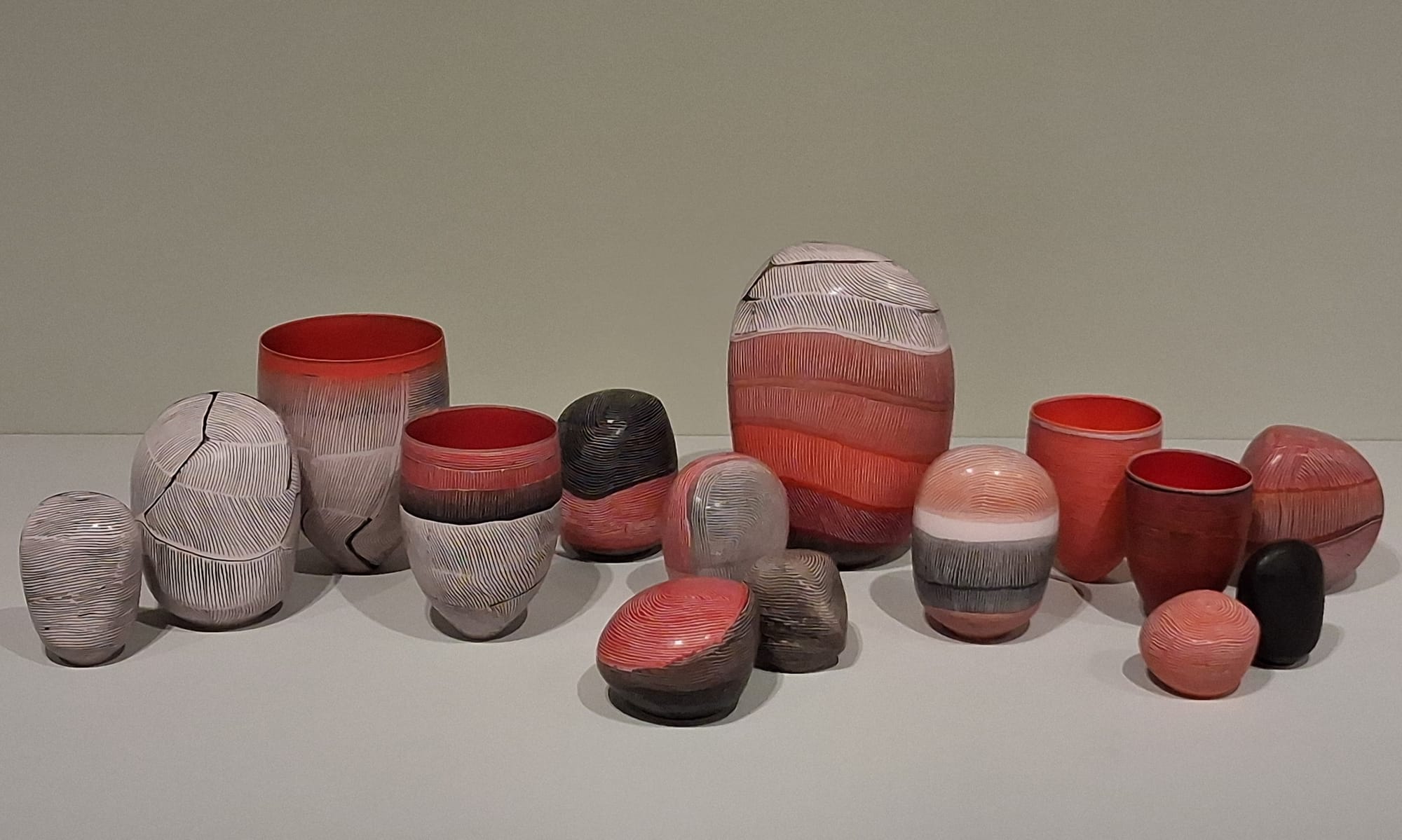
Her long engagement with the Kimberley is everywhere evident. The East Kimberley works, shown here for the first time, read as sculptural chorales: clusters of porcelain forms rising and falling like weathered domes, termite mounds or distant mesas. Their scale encourages bodily navigation; one walks among them as one might traverse the Bungles, where repetition becomes variation and pattern resolves into rhythm. This sense of landscape as orchestration of cadence, pause and return – aligns Drysdale with painters such as Fred Williams and Emily Kame Kngwarreye.
What distinguishes Drysdale from many ceramicists is her mastery of surface as temporal record. The incised lines of the Tanami Traces series ripple like aerial mappings of sand dunes and salt lakes, recalling the desert seen from light aircraft: fragile, linear, endlessly reiterated. These markings situate her within an international dialogue that includes the geological abstractions of Anselm Kiefer and the aerial desert paintings of John Olsen, though Drysdale’s tone is less mythic, more quietly empirical.
Equally compelling is the collaborative dimension of her practice. Since the early 1990s, Drysdale has worked closely with master thrower Warrick Palmateer, a partnership that enables extraordinary technical precision. The consistency of form allows surface to speak with clarity, turning each vessel into a site of investigation rather than expressionist flourish. It is a model reminiscent of Bernard Leach’s workshop ethos, though Drysdale’s visual language is emphatically contemporary.
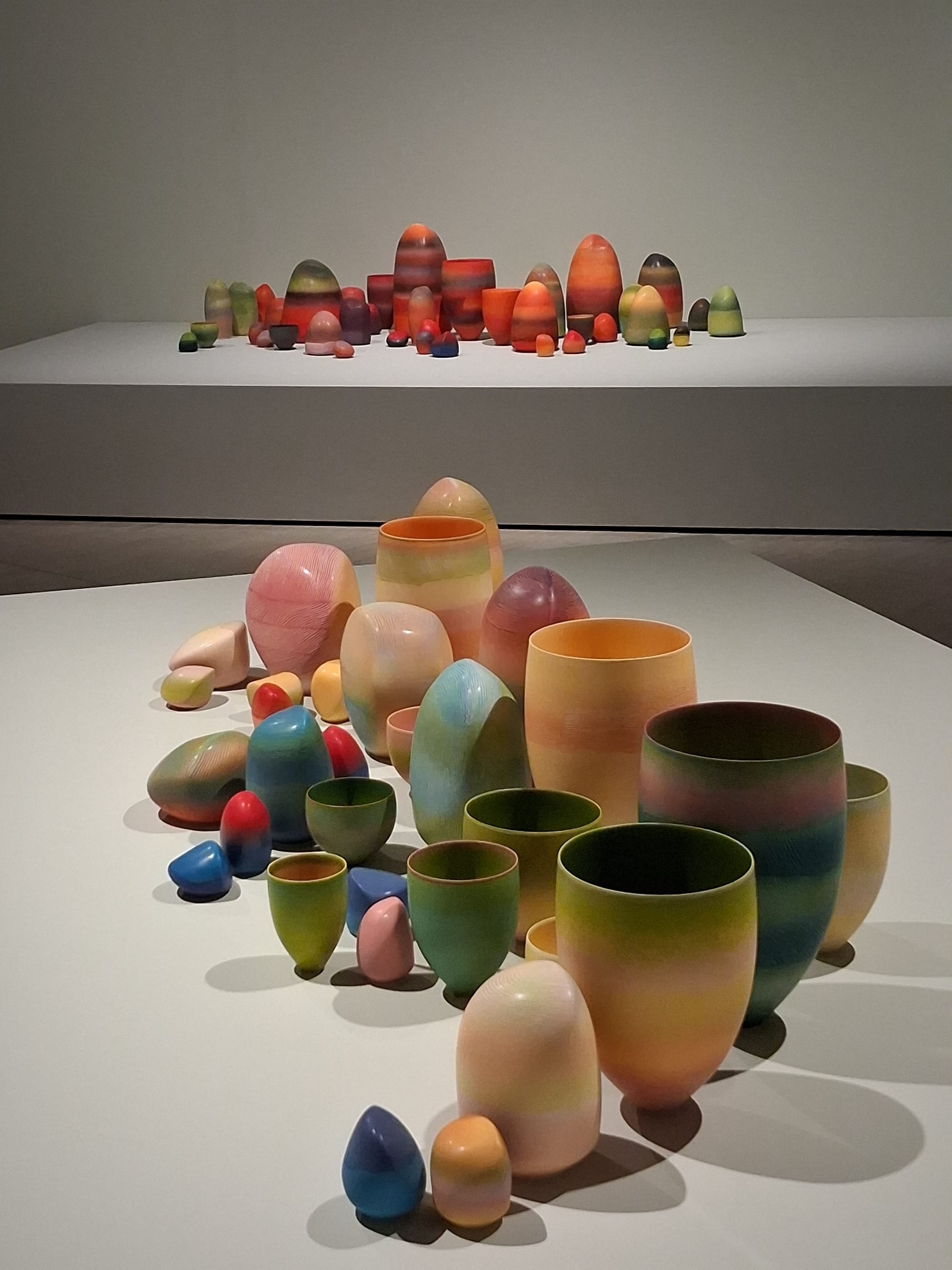
In Swift Parrot Installation, vibrant porcelain forms scatter across a white plinth like fragments of threatened beauty. This is colour as advocacy. The work acknowledges ecological fragility without didacticism, echoing the environmental consciousness found in the late paintings of Arthur Boyd or the installations of Olafur Eliasson.
At 82, Drysdale remains restlessly inquisitive. Infinite Terrain demonstrates not a summation but an ongoing conversation between material, memory and place. Few Australian artists have sustained such fidelity to landscape without lapsing into nostalgia or monumentality. Drysdale’s landscapes breathe, shimmer, persist.
Read Jaimi Wright’s beautiful review of this same exhibition at Seesaw.